 |
| Well memed, my friend. Picture taken from <https://s-media-cache-ak0.pinimg.com/originals/8e/66/fb/8e66fbae5223ea2c26c7939cd7056048.jpg> |
This post is quite different from the previous ones in this blog in that the prior posts have all dealt with games and genres that I particularly like, whereas I have never been particularly fond of RTS games. In fact, the only RTS game that I have really gotten into was Warcraft III: The Frozen Throne, and that was primarily because I loved the world of Warcraft (pun intended). I have also played a fair amount of Total War: Shogun 2 and a bit of Starcraft: Broodwar, but other than that, my experience with the genre has been quite limited. So, while I am by no means an expert on the subject of RTS, I think it is still interesting to look at how the genre has evolved over the years, and arguably somewhat faded into obscurity nowadays.
 |
| I was a scummy Night-Elf player. It is known that the Demon Hunter is the hero of choice for maximum edgelord potential. Picture taken from <http://krakou57.free.fr/War3/Models/Units/NightElf/HeroDemonHunter/HeroDemonHunter.jpg> |
Historically, RTS has been one of the cornerstone genres for video games, with plenty of successful franchises. More recently, however, the genre has been in a somewhat of a slump, with few truly noteworthy titles being released in the last few years (the most notable arguably being Starcraft 2). Overall, it seems like the AAA game industry has largely moved away from the RTS genre, although fortunately series like Total War still remain fairly popular (even if Total War is not a pure RTS game). Generally, however, people looking to get their RTS fix should probably look towards the indie side of the game industry.
 |
| The Total War series offers battles of epic proportions. Picture is from Total War: Shogun 2. |
The Early Days
It is interesting to consider why RTS turned from one of the most popular genres into its current, almost niche state. I assume that one of the main reasons RTS originally established itself as a prominent genre was due to simple technical limitations of the 80s and early 90s: the hardware available could not yet handle 3D graphics, which naturally severely limited the types of games that could be made. Consequently, side scrolling 2D action platformers were probably the "standard" game type during those times. Other prominent genres included (J)RPGs, point-and-click adventure games and, of course, RTS games. A clear benefit of RTS games is that they work well with simple top-down 2D presentation, thus making them relatively easy on the CPU. An additional benefit of the genre is that with proper UI design, they can be played largely with a mouse, simplifying the control scheme (although using keyboard shortcuts is obviously much preferred). |
| An orc base in Warcraft: Orcs & Humans. Picture taken from <http://us.blizzard.com/static/_images/games/legacy/wc4.jpg> |
As the processing power available on PCs and consoles increased, we saw the advent of 3D gaming, which, I would argue, is the single most groundbreaking development in the history of video games. 3D graphics enabled developers to device completely new types of games, as can be witnessed today. While the switch from 2D to 3D revolutionized the industry, it should be noted that RTS games were left fundamentally unchanged; sure, they look nicer with 3D models and environments, but the core gameplay has remained largely intact (although there have been some developments, which are discussed a bit later). Although I think it was necessary to touch upon the technical aspects that played an important part in the history of RTS as a genre, that is not what I want to focus on here. Instead, I want to try and look at what kind of an experience the genre offers, and what makes it distinct from other genres.
What Makes Them Tick?
I suppose I'll start the analysis of RTS games from the letter S, for strategy. As the name of the genre implies, RTS games are ultimately about collecting resources, building armies and beating your enemies' armies in a strategic manner. That is to say, players should have some type of a strategy that they want to execute going into the game, but they should also be capable of adapting to what their opponents are doing. |
| This is at the core of an RTS experience. Picture taken from <http://upload.wikimedia.org/wikipedia/commons/7/77/Waterloo_Campaign_map-alt3.svg> |
Due to the strategical nature of the genre, there tends to be a deep pool of knowledge required to play and enjoy RTS games. One needs to understand the different types of units, buildings, build orders, tech trees, unit compositions, general strategies and also be able to react to what the enemy is doing. The vast amount of initial familiarization required makes RTS one of the most difficult genres to get into for novices. If you compare RTS to FPS, for instance, the difference is like night and day: in FPS games, a new player does not really need to understand a whole lot to be able to enjoy the game on at least some level - you have a gun, you point the gun at stuff and shoot. That's it. RTS games, on the other hand, only really become enjoyable once a certain skill and knowledge threshold has been reached, and the player can start to focus on what to do as opposed to how to do it. Of course the upside of all the complexity is that there is a great deal of depth in RTS games, but uncovering that requires one to stick through the often awkward learning phase.
 |
| It's dangerous to go alone! Take this. Picture taken from <http://pichost.me/1303432/> |
Moving on to the letters R and T, although I generally like strategy games, I am not particularly fond of real-time strategy. This is because in RTS games, the pace of the game is generally high throughout the game, and there is very little chance to pause and really ponder through your options. Furthermore, a basic tenant of the genre is that multitasking is absolutely essential, and players typically have to juggle their attention between micromanaging their army, base building, strategizing and keeping an eye on what their enemy is doing. I find the constant time pressure to be rather stressful, especially when initially learning the game. Naturally, the upside of the time pressure is that even if there is a lull in the fighting, there is still always lots of things to do and decisions to make, and the games typically do not last very long.
 |
| This is pretty much how playing RTS games feels like. Picture taken from <http://mercercognitivepsychology.pbworks.com/f/1385057522/Multitasking.jpg> |
When the above considerations are taken into account, RTS games demand quite a lot from their players: one has to both understand all the different components that there are in the game (such as units and buildings) and be able to keep up with the often frantic pace of the matches. They are certainly not pick-up-and-play types of games, but rather games that reward dedication and skill. This makes them good competitive titles, but not necessarily very appealing for the more casual players.
 |
| A casual after a ladder game of [enter your favorite RTS title here]. Picture taken from <https://media3.giphy.com/media/HJTBvT7cTQqFq/200_s.gif> |
Developments in the Genre
Now that I have briefly discussed what I think the key aspects of RTS as a genre are, I will move on to point out a few ways in which the genre has evolved over the years. The first trend that has emerged is the emphasis of micromanagement over macromanagement (micro refers primarily to controlling your units in battle, whereas macro refers to higher-level strategical decisions, base building and economy management), such as with the newer Dawn of War games. In fact, it has become quite common for newer RTS games to abandon the base building aspects altogether and limit resource gathering to capturing control points on maps, as opposed to the traditional system of mining minerals with dedicated workers. In a sense, it could be argued that the genre has shifted its focus more towards action rather than strategy, with commanding your troops in battle becoming the primary (or even sole) focus of the games.The second trend concerns how the units are handled. Whereas traditionally, one would produce and control single units individually, it has nowadays become more prevalent to replace single units with small squads of a particular unit type. For example in Company of Heroes, there are basic rifle squads and mortar teams that have multiple men, but which function as a single unit. I think this has been a great change, because it reduces some of the tedious micromanagement of controlling every single unit independently, plus it also makes more sense from a real-life military perspective.
 |
| A rifle squad in Company of Heroes. Picture taken from <http://www.mobygames.com/images/shots/l/186195-company-of-heroes-windows-screenshot-a-squad-of-riflemen-on.jpg> |
The third trend is featuring an experience system and customization options for units, thus providing an incentive to keep you troops alive. The basic gist is that as the units get more battle experience, they also grow stronger and often also learn new abilities. Sometimes there are also particularly powerful hero units that can have a major influence on how the battles play out. This is quite different from the more old-school approach of having all units be equal, which reduced particularly the lower-tier units into simple cannon fodder.
The Impact of The RTS Genre
Although RTS as a genre has seen a clear decline in popularity throughout the years, it has, nonetheless, had a major impact on the game industry as a whole. Perhaps most notably, RTS has been responsible in spawning whole new game genres. The new genres may have been born as custom maps for Warcraft III or Starcraft, but eventually outgrew those platforms and established themselves as independent genres. One example is the Tower Defence genre, which is still mildly popular, particularly in the more casual games, such as Plants versus Zombies and Orcs Must Die.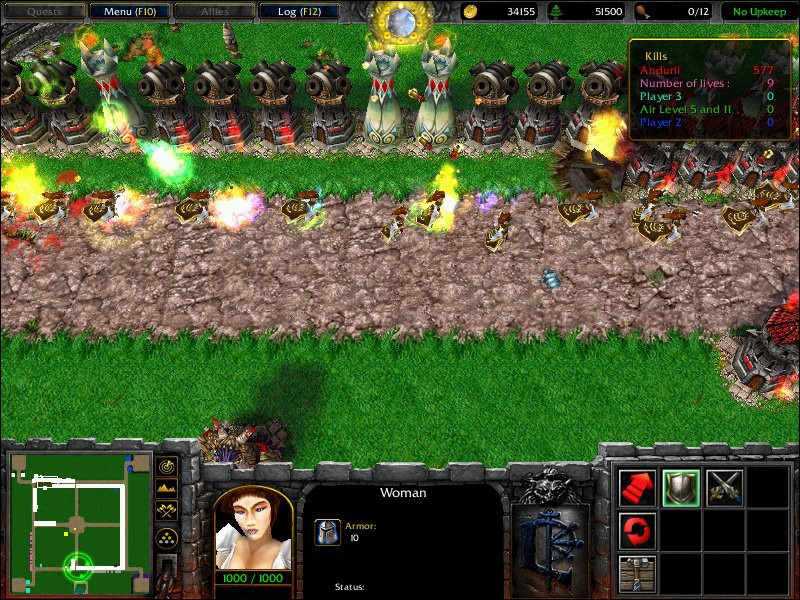 |
| Personally, I never understood the attraction. Picture taken from <http://www.loopinsight.com/wp-content/uploads/2010/03/tower_defense.jpg> |
By far the most notable genre to have spawned from RTS is, of course, MOBA, or Multiplayer Online Battle Arena. I suppose it should be noted that the name of the genre is still a matter of some debate, and there are a variety of alphabet soup acronyms more or less commonly used, such as ARTS (Action Real-Time Strategy). In any case, MOBAs truly have taken the (competitive) gaming world by storm, quickly becoming the hottest genre together with Modern Military Shooters and "wacky" simulator parody games, such as Goat Simulator and I am Bread. I may later write some of my thoughts on why exactly MOBAs have become so immensely popular, despite the fact that the genre suffers from some pretty serious problems. To name a couple, MOBAs are infamous for having a very steep learning curve in terms of all the knowledge a new player has to acquire before being able to really enjoy the game (much more so than RTS games). What is more, MOBAs tend to have a poor gameplay ratio of "intense action going on, butter clench my buttcheeks real tight" and "just farming on my lane, I sure hope something exciting happens soon". Those issues, however, are a subject for another time.


